

All About Cloud Computing Data Security

Table of Contents

Digital transformation and cloud migration are common terms that you’ll hear when referring to secure data and actions in modern business settings. In the past, businesses relied solely on on-premise systems to manage their network of computers and software, but these days, being integrated in the cloud is a necessity regardless of the industry. Cloud computing gives organizations access to high-performance computing power, unlimited storage, and robust data security for a fraction of the cost of on-premise systems.
Cloud computing data security plays a critical role in safeguarding sensitive information and ensuring the privacy and integrity of data stored in the cloud. As more businesses adopt cloud-based solutions, understanding the principles and benefits of cloud data security becomes increasingly important. Businesses also have to ensure that they recognize and prepare to meet challenges that are likely to arise with regard to balancing productivity levels and security when moving to the cloud. Moving from on-premise systems to cloud-based systems requires a proper approach to ensure that organizational security remains intact during and after the transition.
This article explores what cloud computing data security entails and why companies need robust security measures in place. We will also discuss the principles of data security in cloud computing, covering aspects such as data confidentiality, integrity, and availability.
Key Takeaways
- Cloud computing data security is essential for protecting sensitive information as organizations shift away from on-premise systems or integrate hybrid solutions.
- Effective cloud security requires strong controls across confidentiality, integrity, and availability of data.
- Cloud architectures (public, private, hybrid) influence how security is applied and how shared responsibility is divided.
- Businesses must balance productivity and security during cloud migration to avoid misconfigurations and access vulnerabilities.
- Robust data security for cloud computing practices—including encryption, MFA, monitoring, and Zero Trust—ensure resilience against evolving cyber threats.
What is Data Security in Cloud Computing?
Cloud computing data security refers to the protection of data stored, processed, and transmitted within cloud environments. It involves implementing a range of security measures and technologies to mitigate risks and ensure the confidentiality, integrity, and availability of data. Cloud data security encompasses various aspects, including access control, encryption, data backup, and incident response.
Access Control and Encryption
Access control: Manages and restricts user access to sensitive data stored in the cloud. This includes authentication processes, authorization levels, and user permissions. Organizations can prevent unauthorized access and data breaches by implementing robust access control measures.
Encryption: involves converting data into a coded format that can only be accessed with the appropriate decryption key. This helps protect data at rest and in transit within the cloud environment. Strong encryption algorithms are important for data security and cloud computing as they are used to safeguard sensitive information from unauthorized disclosure or tampering.
Importance of Compliance and Certification in Cloud Data Security
Compliance frameworks and industry certifications are essential for validating the security posture of cloud providers. They demonstrate that a provider follows established standards, maintains strong internal controls, and meets regulatory expectations for handling sensitive data. For organizations adopting cloud environments, these certifications serve as an assurance that the underlying infrastructure aligns with recognized best practices.
Key certifications include:
| Certification Standard | Description |
| ISO27001 | International standard for implementing and maintaining an information security management system (ISMS), focused on structured risk management and continuous improvement. |
| SOC2 | Assesses a provider’s controls around cloud computing data security, availability, processing integrity, confidentiality, and privacy. |
| HIPAA | Establishes requirements for safeguarding protected health information (PHI) in healthcare-related environments. |
| ITAR | Regulates the handling of U.S. defense-related data, requiring strict access controls, auditing, and geographic data residency restrictions. |
| PCI DSS | Security standard for organizations handling payment card data, focused on preventing fraud and ensuring secure processing, storage, and transmission of cardholder information. |
| GDPR | European Union regulation governing data privacy and protection, emphasizing user consent, data minimization, and strict controls over personal data handling and processing. |
For ITAR-controlled workloads specifically, encryption and strict data residency are critical. Providers must ensure both data-at-rest and data-in-transit protections, as well as mechanisms that keep all regulated information within approved U.S. boundaries.
Achieving and maintaining these certifications requires ongoing audits and continuous security improvements. Providers that adhere to these standards not only strengthen their infrastructure but also increase customer confidence in the security of their cloud environments.
Why Companies Need Cloud Computing Data Security
Many businesses are leveraging cloud computing for its scalability, flexibility, and cost-effectiveness. However, without robust security measures, sensitive information is susceptible to unauthorized access, theft, or corruption.
Security considerations also vary depending on the underlying cloud architecture—public, private, or hybrid:
- Public cloud environments typically rely on shared, multi-tenant infrastructure, which introduces broader threat surfaces and requires strict isolation controls.
- Private cloud environments typically offer a more controlled security posture with single-tenant access, simplified visibility, and predictable performance.
- Hybrid models add complexity by requiring unified controls across both on-premise and cloud systems. These architectural differences influence how organizations must design identity, access, monitoring, and data protection policies.
By implementing stringent data security measures, companies can mitigate the risks associated with cloud computing for data security and protect valuable assets. Effective cloud computing and data security measures within cloud instances safeguard confidential information, enhance customer trust, comply with regulatory requirements, and minimize financial and reputational damage caused by data breaches.
Encryption is an essential part of this process. Proper encryption of data ensures that even if data is intercepted, it remains unreadable to unauthorized users. Additionally, companies can implement multi-factor authentication protocols to add an extra layer of cloud computing data security, requiring users to provide multiple forms of verification before accessing sensitive information.
In addition, administrators can limit user access to certain aspects of a system based on Zero Trust principles, which are described in more detail in the table below:
| Zero Trust Principle | Meaning |
| Verify explicitly | Authentication is taken very seriously, and every user is authenticated based on all available data points, including user identity, location, device, service or workload, data classification, and anomalies. |
| Use least privilege access | Each user only receives the access privileges that they need to do their work, which is referred to as “just enough access.” Risk-based adaptive policies like this, as well as data protection measures, help secure data and productivity. |
| Always assume a breach | When you always assume a breach, you minimize the blast radius and segment access. End-to-end encryption verification and analytics give you visibility, drive threat detection, and help you improve your defenses. |
Regular security audits and penetration testing are other essential components of a comprehensive cloud computing data security strategy. These measures help identify vulnerabilities in the system and address them proactively, reducing the likelihood of successful cyber attacks. By staying proactive and continuously updating security protocols, companies can stay one step ahead of cyber threats and protect their data assets effectively.
The Cloud Shared Responsibility Model Explained

The shared responsibility concept considers the diversity of the different cloud architectural models, distributing security responsibilities between the provider and the customer depending on the cloud type. In public clouds, providers typically manage the infrastructure layer, while customers must secure data, identities, configurations, and workloads. In private and dedicated environments, organizations gain significantly more operational control—particularly over network access, system design, and firewall configurations—reducing the ambiguity and risk associated with shared responsibility in multi-tenant platforms.
Provider Responsibilities
Cloud providers typically handle the foundational components that support the cloud environment. This includes:
- Physical security of data centers
- Core infrastructure security (compute, storage, networking)
- Hypervisor and virtualization layers, where applicable
These provider-level controls establish the secure infrastructure upon which customers operate their workloads.
Customer Responsibilities
Customers are responsible for protecting the data, identities, and applications within their cloud environment. Key areas include:
- Identity and access management (IAM)
- Data governance, including classification, retention policies, and lifecycle management
- Application security, covering workload hardening and vulnerability mitigation
- User behavior monitoring and internal access controls to reduce insider risk
Together, these responsibilities ensure that the organization maintains control over how its users and applications interact with cloud resources.
How Responsibility Shifts by Cloud Type
The degree of responsibility each party carries depends on the structure of the cloud environment:
- Public cloud: The provider controls the underlying infrastructure, while customers retain responsibility for securing data, IAM, encryption, and workload configurations. This model offers flexibility but increases the customer’s operational burden.
- Private cloud: Enterprises gain substantially more authority over environment configuration, access pathways, and data flow visibility. Security design becomes far more customizable, allowing tighter governance and monitoring.
- Hybrid cloud: Responsibility is distributed across on-premises and cloud environments, requiring organizations to coordinate identity governance, configuration management, and network security across both domains. Because data frequently moves between environments, secure connectivity, unified monitoring, and consistent policies are essential to prevent gaps in coverage.
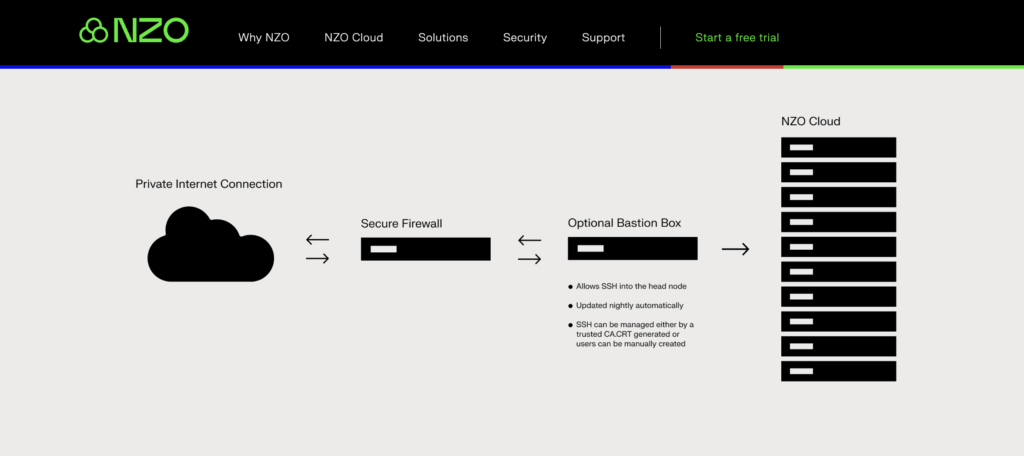
Example: In NZO Cloud’s dedicated, single-tenant architecture, customers benefit from their own firewall, customer-defined access controls, and private IP access. This reduces ambiguity in responsibility boundaries and provides clearer oversight compared to traditional multi-tenant public cloud computing data security models.

Key Components of a Cloud Data Security Framework
A mature data security and cloud computing framework provides the structure required to safeguard sensitive information throughout its lifecycle. Because cloud environments introduce unique operational risks—ranging from multi-tenant exposure to configuration drift—organizations need a framework that integrates identity governance, secure configuration practices, network controls, telemetry, and lifecycle management. A well-designed framework also ensures alignment with compliance standards and business objectives, especially when high-performance or research-driven workloads are involved.
Identity & Access Management (IAM)
IAM establishes who can access what, under which conditions, and with what level of privilege. In modern cloud security, IAM is foundational because most breaches stem from compromised identities or excessive permissions. Core IAM requirements include:
- Enforcing least-privilege access across users, workloads, automation, and service accounts.
- Multi-factor authentication for all administrative functions.
- Strong governance of role creation, privilege escalation, and dormant accounts.
- Standardized access patterns to make deviations easier to detect—something NZO Cloud supports through tightly controlled, single-tenant environments.
A cloud strategy that prioritizes IAM significantly reduces unauthorized access risk and improves auditability across sensitive data operations.
Secure Configuration & Posture Management
Misconfigurations remain the leading cause of cloud breaches. Configuration and posture management (CSPM) ensures that cloud assets remain compliant with internal policies and industry benchmarks. Key practices include:
- Continuous scanning for insecure configurations, such as open storage buckets or publicly exposed endpoints.
- Enforcing baseline templates for compute, storage, and network resources.
- Automated remediation of high-risk deviations, reducing manual overhead.
- Ensuring that security controls remain consistent across application updates and new deployments.
Dedicated environments reduce configuration complexity by eliminating the multi-tenant layers that often introduce drift or inconsistent security enforcement.
Network Security Controls (Firewalls, Bastion Boxes, Private Connectivity)
The network layer is a critical enforcement point for controlling data flow into and out of cloud environments. Effective security requires layered, user-defined controls—including:
- Firewalls: Custom-configured filtering to restrict inbound and outbound traffic at a granular level. NZO Cloud’s dedicated firewalls give organizations full authority over rules and configurations.
- Bastion Boxes: Hardened gateways that provide controlled administrative access, minimizing exposure of internal systems.
- Private Connectivity: Static, dedicated IP addressing and private routing to ensure data flows only through known, validated paths. This reduces the attack surface and prevents unauthorized lateral movement.
These controls work best in dedicated cloud architectures where the organization owns the networking stack end-to-end.
Monitoring, Logging, and Real-Time Alerting
Visibility is essential for detecting both fast-moving threats and subtle behavioral drift. Modern cloud monitoring aggregates signals across identity activity, workloads, configuration changes, and network traffic. A strong monitoring approach includes:
- Log centralization and secure log retention.
- Behavioral analytics to identify anomalies.
- Real-time notifications for high-risk events such as unauthorized login attempts, configuration changes, or data exfiltration.
- Integration with SIEM platforms or cloud-native telemetry systems.
Dedicated, high-performance cloud environments provide cleaner, low-noise telemetry because no unrelated tenants introduce background activity, making threat detection significantly more reliable.
Data Lifecycle Management (Retention, Deletion, Sovereignty Requirements)
Data protection does not end at encryption and access control. Organizations must manage data responsibly throughout its lifecycle. This includes:
- Retention policies that align with regulatory obligations and operational needs.
- Secure deletion processes to prevent residual data exposure after disposal or migration.
- Data residency and sovereignty considerations that dictate where data must physically reside.
- Versioning and archival strategies for long-term scientific, research, or regulatory data.
Dedicated cloud infrastructures give organizations clarity over where data is stored and who can physically access the underlying systems—critical for industries such as life sciences, higher education, and government.
Types of Cloud Security Risks and Threat Vectors
Cloud environments introduce threat vectors that differ from traditional on-premises systems. Many risks arise from the abstraction layers, shared infrastructure, and distributed services of mainstream public clouds. Understanding these risks enables organizations to design cloud strategies that reduce exposure and maintain operational continuity.
1. Misconfigured Cloud Resources
Misconfiguration of storage, compute instances, databases, or network components remains the leading cause of cloud security incidents. These failures often stem from publicly accessible storage buckets, overly permissive security groups or firewall rules, disabled logging, unmonitored administrative channels, and incorrect encryption settings. In contrast, dedicated infrastructure significantly reduces the misconfiguration surface area by removing unnecessary shared services, default public endpoints, and the architectural complexity inherent in cross-tenant environments.
2. Shared-Tenancy Vulnerabilities vs. Dedicated Environments
Traditional cloud models are built on multi-tenant resource sharing, which introduces risks such as hypervisor escape attacks, noisy-neighbor interference that disrupts security tooling, and limited visibility into neighboring workloads. These conditions increase the likelihood of lateral movement or cross-tenant exposure. Dedicated environments eliminate these risks by providing complete workload isolation, enabling organizations to control the underlying hardware, networking, and access paths directly. This architectural approach removes entire classes of vulnerabilities that exist only in shared-tenant clouds.
3. Data Breaches and Unauthorized Access
A significant proportion of cloud breaches result from compromised credentials, insecure APIs, or improperly exposed data repositories. As organizations move massive datasets through AI, HPC, and scientific workflows, their exposure grows, particularly when weak IAM policies, misconfigured encryption, externally accessible management interfaces, or inconsistencies in virtualized infrastructure are present. Dedicated single-tenant cloud environments reduce these unauthorized access vectors by ensuring that only one organization interacts with the hardware stack, narrowing potential entry points for attackers.
4. Insider Threats and Privilege Misuse
Insider threats—both malicious and unintentional—become difficult to detect without disciplined governance. Excessive privilege assignments, shared administrative credentials, or unmonitored access pathways can lead to data exfiltration, deletion or corruption of critical datasets, and unauthorized manipulation of workloads. Organizations can mitigate these risks by tightening identity governance, minimizing privileged roles, enforcing strict firewall and access controls, and implementing full auditing across all administrative actions.
5. Supply Chain & API Security Risks
Modern cloud ecosystems rely on third-party services, vendor-supplied components, and extensive API integration, all of which introduce supply-chain risk. Common vulnerabilities include compromised dependencies, insecure or exposed APIs, weaknesses in external monitoring or management tools, and lock-in created by proprietary cloud services that obscure operational transparency. Dedicated cloud environments reduce these risks by limiting unnecessary third-party integrations and providing engineering-grade control over system design, component selection, and API exposure.
Benefits of a Strong Cloud Data Security Strategy

A comprehensive cloud data security strategy delivers operational, financial, and compliance advantages that extend across the entire organization. Because modern workloads increasingly depend on distributed compute, real-time analytics, and large-scale data movement, strengthening cloud security directly supports continuity, innovation, and long-term business value. Key benefits include:
1. Reduced Risk of Data Breaches and Operational Disruptions
A well-implemented security framework minimizes the likelihood of unauthorized access, misconfigurations, and lateral movement within cloud environments. By strengthening identity governance, enforcing secure network pathways, and monitoring all activity in real time, organizations significantly reduce the risk of costly breaches, downtime, and data loss events.
2. Greater Visibility and Control Over Cloud Environments
The most difficult security incidents to manage are those that occur without being detected. Robust monitoring, logging, and configuration management provide security teams with end-to-end visibility across infrastructure, workloads, and data. This visibility accelerates detection, reduces incident response times, and enhances the organization’s ability to investigate and remediate security issues.
3. Improved Compliance Posture and Audit Readiness
Data protection regulations increasingly require strict controls over who can access data, how it is processed, where it resides, and how long it is retained. A structured cloud security strategy—with defined policies, lifecycle management, encryption practices, and audit logging—helps organizations meet requirements across frameworks such as ISO 27001, HIPAA, SOC 2, GDPR, and industry-specific mandates.
4. Enhanced Business Continuity and Resilience
Security is directly connected to uptime. Strong cloud data protection supports:
- reliable access to mission-critical systems
- consistent workload performance
- validated disaster recovery and failover capabilities
- reduced exposure to configuration drift or environmental instability
Organizations benefit from fewer interruptions, smoother operations, and stronger safeguards for high-value workloads.
5. Long-Term Cost Efficiency
Although security investments may appear to add operational overhead, they reduce far larger downstream risks—breach remediation, regulatory penalties, unplanned downtime, and inefficient manual processes. Security automation, configuration baselines, and identity governance also reduce staff workload and prevent the expensive consequences of human error.
6. Increased Trust Across Customers, Partners, and Regulators
A mature cloud security program signals reliability, professionalism, and operational discipline. For organizations conducting research, processing sensitive personal data, or collaborating with regulated industries, strong cloud security practices directly strengthen stakeholder confidence and create competitive differentiation.
7. Operational Agility for Modern Workloads
When security controls are embedded into cloud architecture—from access management to data lifecycle practices—teams can deploy workloads faster and with greater confidence. This reduces delays in AI development, simulation pipelines, and other compute-intensive workloads that depend on fast, secure processing of large datasets.
How Dedicated Cloud Environments Improve Data Security
Dedicated cloud environments—such as those architected on PSSC Labs hardware and delivered through NZO Cloud—provide a fundamentally stronger security posture than shared public-cloud platforms. By removing multi-tenancy, reducing the overall attack surface, and delivering consistent, high-performance compute capabilities for HPC, AI, and scientific workflows, these environments support both operational integrity and stringent security requirements.
Elimination of Resource Sharing and Noisy Neighbors
Multi-tenant clouds host multiple organizations on the same physical machines, increasing exposure to issues that do not exist in isolated deployments. Dedicated environments eliminate:
- Hypervisor-level intrusion opportunities.
- Side-channel or inference risks arising from co-located workloads.
- Performance fluctuations that compromise security tooling and critical applications.
Because no virtualization or shared compute layers are present, organizations maintain direct control over their security boundaries and system behavior.
Enhanced Network Visibility and Control
Isolated network architectures allow organizations to construct a connectivity model without competing tenant traffic or opaque underlying infrastructure. This results in:
- Complete insight into all inbound and outbound activity.
- Uniform firewall rule enforcement across the entire environment.
- The ability to trace every connection and data transfer event.
- Improved anomaly detection due to substantially cleaner telemetry.
Static, dedicated IP structures reinforce accountability by ensuring predictable and traceable access pathways.
Predictable Performance for Security-Critical Workloads
Security operations rely on uninterrupted throughput for scanning, analytics, and log processing. In shared public clouds, tenant interference or throttling can degrade these functions. Dedicated environments provide:
- High-performance compute capacity without the penalties of virtualization.
- Steady processing rates for large-scale AI and HPC workloads.
- Accelerated security analysis and faster response times.
Such reliability is vital for research, engineering, and government use cases that demand both precision and uninterrupted availability.
Dedicated Firewalls and Bastion Access Models
A dedicated cloud design ensures that organizations define and manage the security perimeter themselves. Core practices include:
- Firewalls fully controlled by the customer to regulate all traffic flows.
- Optional bastion hosts that restrict administrative interfaces.
- Ingress and egress points not shared with other tenants.
- Private routing options to safeguard sensitive operational data.
This structure gives organizations uncompromised authority over how access is granted and monitored.
Physical Isolation Benefits through PSSC Labs Hardware
Physical isolation further strengthens the security profile of dedicated cloud environments. By operating on exclusive PSSC Labs hardware, organizations gain:
- Sole use of all compute, network, and storage components.
- Confidence that no external workloads coexist on the same system.
- Clear understanding of data locality and movement.
- Reduced susceptibility to physical threats common in multi-tenant infrastructures.
These characteristics make physically isolated environments well suited for regulated sectors and workloads with strict governance, residency, or sovereignty demands.
Challenges of Data Security in Cloud Computing & How NZO Cloud Helps
Challenges of Data Security in the World of Cloud Computing & How NZO Cloud Helps
Data security in cloud computing introduces a wide range of obstacles that organizations must address to protect mission-critical information. As more businesses adopt cloud platforms to store and process data, they encounter several recurring challenges:
- Data breaches: Cloud platforms remain attractive targets for attackers who exploit infrastructure weaknesses or rely on tactics such as malware and credential theft to access sensitive records.
- Identity and Access Management (IAM): Administering identities and privileges across different services is complex, and gaps in authentication or access control routinely lead to unauthorized exposure.
- Data loss: Accidental deletions, system failures, or malicious actions can result in loss of important data unless robust backup and recovery processes are in place.
- Insider threats: Individuals with elevated privileges—whether careless or malicious—can compromise critical information, underscoring the need for strict monitoring and controlled access pathways.
- Shared responsibility model: Cloud providers secure infrastructure, but customers are responsible for their data and applications. Without clearly defined roles, organizations may leave critical gaps unaddressed.
- Data encryption: Implementing encryption for data at rest and in transit is vital, but achieving strong protection while maintaining usability and performance can be difficult.
- Security misconfigurations: Incorrect settings or insufficiently managed controls frequently expose assets to attack, making ongoing audits and configuration oversight essential.
With NZO Cloud, businesses benefit from:
- Tailored deployment: Instead of adapting workflows to generic cloud templates, organizations receive a customized deployment aligned with their operational requirements, ensuring they get precisely the infrastructure they need.
- Transparent pricing: Traditional high-performance and cloud security platforms often impose unpredictable storage and transfer charges. NZO Cloud’s standardized subscription model eliminates such variability, allowing organizations to avoid unexpected expenses and maintain predictable budgets.
- Dedicated support: Large cloud providers typically struggle to offer individualized assistance. NZO Cloud provides continuous, hands-on onboarding and access to security engineering resources, ensuring that organizations receive focused expertise and reliable operational support.
Building a Strong Cloud Data Security Strategy: Enterprise Checklist
Developing an effective cloud data security strategy requires a structured, repeatable approach. The following checklist provides practical steps enterprises can use to strengthen their cloud posture, reduce risk, and ensure compliance across all environments.
| Security Priority | Checklist Action |
| Understand your cloud shared responsibility roles | Confirm which security controls belong to you versus your cloud provider, and adjust internal policies accordingly based on cloud type (public, private, hybrid, or dedicated). |
| Implement strong IAM policies | Apply role-based access control (RBAC), enforce MFA, and limit privileges to the minimum necessary for each user or service. |
| Enforce encryption at rest and in motion | Ensure all sensitive data is encrypted using modern algorithms, and manage keys securely through dedicated key management systems. |
| Maintain continuous monitoring and logging | Enable real-time monitoring, centralized logging, and automated alerting to detect anomalies early. |
| Classify and segment sensitive data | Identify high-value or regulated datasets, apply appropriate access tiers, and segment workloads to minimize risk exposure. |
| Perform regular audits and penetration tests | Conduct scheduled security reviews, configuration audits, and third-party penetration tests to uncover vulnerabilities before attackers do. |
| Select a cloud partner that enhances—not complicates—your control | Choose providers offering clear visibility, dedicated resources, and straightforward security governance. |
Conclusion
Cloud computing data security is essential for protecting sensitive information and meeting regulatory requirements. By applying strong controls—such as encryption, access management, monitoring, and incident response—organizations can maintain data confidentiality, integrity, and availability across cloud environments. Compliance with standards like ISO27001, SOC2, HIPAA, and ITAR further strengthens trust and ensures alignment with industry expectations.
Although cloud security introduces challenges such as evolving threats, identity management, and configuration risks, the right infrastructure partner can simplify this complexity. NZO Cloud provides dedicated, non-virtualized resources, transparent pricing, and expert support, enabling businesses to maintain control while reducing operational burden. With NZO Cloud, organizations can confidently secure their cloud environments and protect their most valuable data assets.
Reach out to us today for a free trial to discover how we can help you build your cloud security solution for your business.