

Cloud Computing Cost Savings: Hidden Costs & What to Know

Table of Contents

Cloud computing has revolutionized the way businesses operate by providing flexible and scalable IT infrastructure. However, amidst the benefits, there are potential hidden costs that organizations often overlook.
Cloud computing cost savings refer to the measurable reduction of infrastructure spend through intentional design, governance, and pricing strategy. For high-performance workloads, savings are not achieved by “using less cloud,” but by ensuring that every dollar spent maps directly to compute, storage, and network performance that drives outcomes.
In this article, we will explore the various aspects of the cost of cloud computing and help you better understand what you need to know.
Key Takeaways
- Hidden cloud costs are rarely “mystery fees”—they’re the result of design choices. Instance selection, storage tiers, network topology, and high-availability defaults quietly shape your long-term cost structure, especially in HPC and AI environments where workloads run continuously.
- Cloud cost savings come from performance alignment, not simply “using less cloud.” The goal is maximizing performance per dollar—ensuring every spend category (compute, storage, networking) maps directly to measurable throughput, job completion speed, or workload output.
- The “Big 3” pricing model creates fragmentation by design. Compute, storage, networking, and add-ons are metered separately, which makes billing complex and cost optimization difficult without strong engineering governance and continuous validation.
- Engineering controls cloud cost because most spend is locked in at build time. Overprovisioning bias, expensive defaults, and configuration drift (snapshots, backups, idle replicas, lingering dev/test) compound into recurring waste unless prevented with guardrails and automation.
- Structural waste is where cloud savings are lost. Virtualized instance bundles, idle environments, misconfigured workloads, hidden network transfer charges, and commitment mismatches are the most common reasons cost savings stall after analysis.
- Subscription pricing reduces volatility for sustained HPC utilization. For 24/7 workloads, metered usage and commitment arbitrage often produce unpredictable spend. NZO Cloud’s fixed subscription model removes surprise charges and stabilizes budgeting by design.
- Hardware precision and software predictability work best together. Organizations can use PSSC Labs for dedicated, purpose-built infrastructure and NZO Cloud for predictable pricing, security control, and customized deployments—creating cost efficiency that’s repeatable, not reactive.
- Sustained savings require metrics and operational discipline—not more reporting. The most reliable programs measure savings realized vs. identified, time-to-remediation, waste prevention rate, and performance-to-cost ratio, then enforce continuous validation to prevent cost regression.
Cost Benefits of Cloud Computing (When Done Right)
Cloud computing delivers the greatest financial advantage when cost, performance, and design are aligned. In HPC and AI contexts, poorly structured cloud environments often erase theoretical savings. Properly engineered cloud infrastructure converts flexibility into measurable economic gain.
1. Scalability and Flexibility for Compute-Intensive Workloads
Cloud platforms allow resources to scale according to demand. For engineering simulations, genomics pipelines, or AI model training, this elasticity reduces idle capital. When deployed on dedicated infrastructure rather than shared virtualization layers, scaling also preserves performance integrity.
2. CapEx to OpEx Conversion
Traditional on-premise HPC clusters require substantial capital expenditure for hardware acquisition, refresh cycles, and facility overhead. Cloud environments shift this burden to operational expense. NZO Cloud’s fixed subscription pricing further simplifies budget allocation by eliminating the variability of metered billing.

3. Precision Right-Sizing Through Custom Instance Design
Elasticity alone does not guarantee efficiency. Standardized, shared instances often introduce unused overhead and virtualization penalties. With PSSC Labs, organizations can design custom cloud instances tailored to their needs, specifying exact CPU architectures, memory ratios, GPU models, and storage tiers. This precision ensures organizations pay only for compute aligned to application requirements—nothing more.
4. Operational Efficiency and Managed Support
Hardware lifecycle management, firmware updates, security patching, and performance tuning shift away from internal IT teams. NZO Cloud augments this with onboarding and security engineering teams, reducing deployment friction and accelerating time-to-production.
5. Continuous Access to Advanced Hardware
Cloud environments eliminate hardware obsolescence risk. Through PSSC Labs’ dedicated infrastructure model, customers gain access to the latest Intel, AMD, and NVIDIA technologies without capital refresh cycles. Performance improvements compound ROI over time.
6. Global Accessibility and Collaboration
Distributed research teams, engineering firms, and higher education institutions benefit from centralized data access. Secure remote access reduces physical infrastructure duplication while supporting global collaboration.
7. Usage-Based vs. Subscription Economics
Usage-based billing benefits short-term experimentation but becomes unpredictable for sustained HPC utilization. Subscription pricing provides fixed monthly cost structures with greater computational density for the same budget compared to traditional hyperscale providers. Predictable cost per core-hour simplifies forecasting and aligns infrastructure with long-term research programs.
Cloud Cost Comparison By Service Provider
Before diving into the intricacies of cloud computing costs, let’s start with a high-level the cost of cloud computing, let’s start with a high-level cloud computing cost comparison of the major cloud service providers—AWS, Azure, and Google Cloud. While each offers similar services, their pricing structures and models vary significantly.
A summary of the pros and cons of the cost of cloud services of the most popular cloud providers is listed in the table below:
| Provider | Pros | Cons |
| AWS | Flexible pay-as-you-go model, wide range of services, significant savings with long-term plans, largest global reach | Complex pricing, high costs for short-term usage, and additional data transfer costs |
| Azure | Seamless integration with Microsoft products, competitive pricing, and Azure Hybrid Benefit | Complex licensing, learning curve for non-Microsoft users, and less extensive data center presence than AWS |
| Google Cloud | Sustained use discounts, custom machine types, advanced analytics, and AI capabilities | Limited enterprise adoption, complex cost management, and high costs for premium support plans |
AWS Pricing Structure
AWS offers a comprehensive and flexible pricing model based on a pay-as-you-go structure. Here are some key components:
- EC2 Instances: Prices start as low as $0.0116 per hour for t3.micro instances and can go up to several dollars per hour for larger, more powerful instances like the p4d.24xlarge, which costs around $32.77 per hour.
- S3 Storage: Storage costs begin at $0.023 per GB for the first 50 TB per month, with reduced rates for higher usage tiers.
- RDS (Relational Database Service): Pricing varies widely based on the instance type and database engine, with costs ranging from $0.017 per hour for db.t3.micro instances to over $10 per hour for high-end db.r5.24xlarge instances.
Positives of this Pricing Structure:
- Flexibility: The pay-as-you-go model provides great flexibility, allowing businesses to scale resources according to demand, which is cost-effective during low usage periods.
- Comprehensive Services: AWS offers a wide range of services, including advanced machine learning and analytics capabilities, providing a one-stop solution for various business needs.
- Savings Plans: Significant cost savings (up to 75%) through Reserved Instances and Savings Plans for long-term commitments.
- Global Reach: AWS has the largest network of data centers, ensuring high availability and low latency worldwide.
Negatives of this Pricing Structure:
- Complex Pricing: AWS’s pricing can be complex and difficult to understand, requiring careful management to avoid unexpected costs.
- High Costs for Short-Term Usage: While flexible, pay-as-you-go pricing can become expensive for short-term, high-demand usage if not managed properly.
- Additional Costs for Data Transfer: Data transfer between AWS regions and out to the internet can incur additional costs, which can add up significantly.
Azure Pricing Structure
Azure’s pricing is competitive and integrates well with other Microsoft products, offering various pricing options:
- Virtual Machines: Prices start at around $0.008 per hour for B1S instances and can exceed $20 per hour for larger instances like the M208ms_v2.
- Azure Blob Storage: Standard performance hot tier starts at $0.0184 per GB for the first 50 TB, with reduced rates for larger volumes.
- Azure SQL Database: Pricing begins at $0.000145 per DTU per hour, with multiple service tiers and performance levels available.
Positives of this Pricing Structure:
- Integration with Microsoft Products: Azure integrates seamlessly with other Microsoft products, making it an ideal choice for businesses already using Microsoft software.
- Competitive Pricing: Azure offers competitive pricing with various options, including pay-as-you-go and reserved instances, providing flexibility and cost savings.
- Azure Hybrid Benefit: This feature allows businesses to use their existing on-premises Windows and SQL Server licenses, reducing costs.
Negatives of this Pricing Structure:
- Complex Licensing: The licensing for Microsoft products can be complex, and understanding the full cost implications can be challenging.
- Learning Curve: Organizations unfamiliar with Microsoft environments might face a learning curve in utilizing Azure’s services effectively.
- Regional Availability: While expanding, Azure’s data center presence is not as extensive as AWS, potentially affecting latency and availability in certain regions.
Google Cloud Pricing Structure
Google Cloud stands out for its data analytics and machine learning capabilities, with competitive pricing structures:
- Compute Engine: N1-standard-1 instances start at around $0.0475 per hour, while custom machine types allow for precise resource allocation and cost control.
- Cloud Storage: Standard storage pricing begins at $0.020 per GB per month, with various storage classes offering different rates.
- Cloud SQL: Pricing starts at $0.017 per hour for db-f1-micro instances and varies significantly with larger instances and different database engines.
Positives of this Pricing Structure:
- Sustained Use Discounts: Google Cloud offers automatic discounts for sustained use of its resources, which can provide substantial savings.
- Custom Machine Types: Users can create custom machine types tailored to their specific needs, optimizing performance and cost-efficiency.
- Advanced Analytics and AI: Google Cloud excels in data analytics and machine learning capabilities, making it a strong choice for data-intensive applications.
Negatives of this Pricing Structure:
- Limited Enterprise Adoption: Compared to AWS and Azure, Google Cloud has a smaller enterprise adoption, which might impact the availability of third-party integrations and support.
- Complex Cost Management: Managing costs in Google Cloud can be complex due to the variety of pricing options and potential hidden costs.
- Support Costs: While Google Cloud offers robust support, premium support plans can be expensive, especially for smaller businesses.
Comparing Pricing Models: Pay-as-You-Go vs. Subscription-Based Pricing
Choosing the right cloud pricing model is essential for managing cloud costs effectively. Two primary models dominate the cloud services landscape: pay-as-you-go and subscription-based pricing. Each has its unique benefits and is suited to different business needs.
Pay-as-You-Go
With pay-as-you-go pricing, you only pay for the resources you actually use. This highly flexible and scalable model makes it ideal for businesses with fluctuating demand and unpredictable workloads. Key advantages include:
- Cost Efficiency: Businesses can scale resources up or down based on current demand, ensuring they only pay for what they use.
- No Long-term Commitment: This model eliminates the need for long-term contracts, which is particularly beneficial for startups and small businesses aiming to minimize upfront costs.
- Flexibility: Allows businesses to quickly adapt to changes in workload without worrying about fixed resource limits.
Subscription-Based Pricing
Subscription-based pricing involves committing to predefined packages that offer a fixed set of resources over a specific period. This model is suitable for businesses with stable workloads and predictable resource requirements. Key advantages include:
- Cost Predictability: Fixed monthly or annual payments provide clear visibility into cloud spending, helping businesses budget more effectively.
- Discounted Rates: Long-term commitments often come with discounted rates, making this model more cost-effective for consistent resource usage.
- Resource Stability: Ensures access to a defined set of resources, which can be crucial for businesses that require guaranteed performance and availability.
NZO Cloud and Subscription-Based Pricing
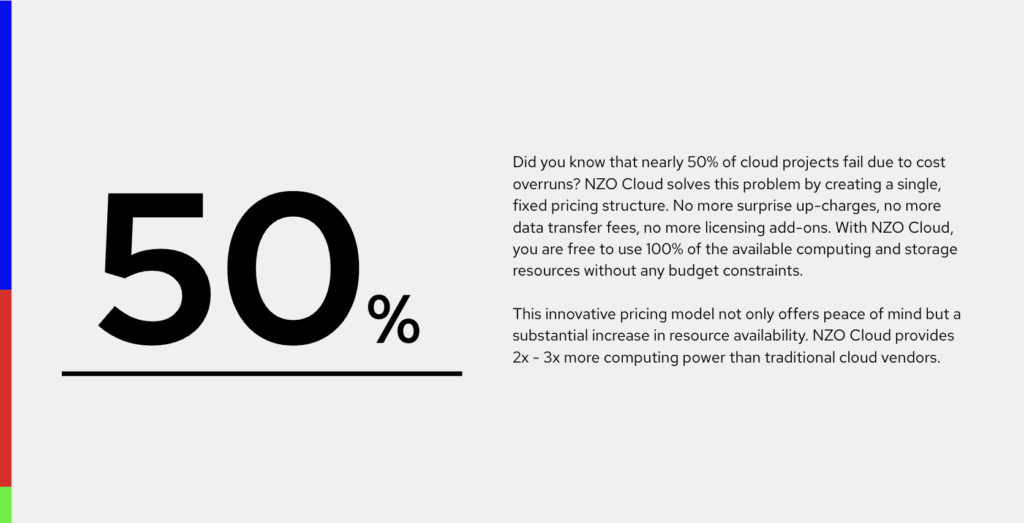
NZO Cloud offers a compelling subscription-based pricing model designed to provide businesses with the benefits of stability and predictability to reduce their overall cost of cloud computing. By opting for NZO Cloud’s subscription packages, businesses can enjoy:
- Consistent Performance: Guaranteed access to resources ensures that your applications and services run smoothly without interruption.
- Cost Savings: Subscription plans are often priced more competitively than pay-as-you-go options, providing better value for money over time. NZO Cloud offers a straightforward subscription-based pricing model, which gives you peace of mind with your monthly cloud cost budget and provides twice as much computing power compared to the big three brands.
- Simplified Budgeting: Fixed costs make it easier for businesses to plan their finances and avoid unexpected expenses.
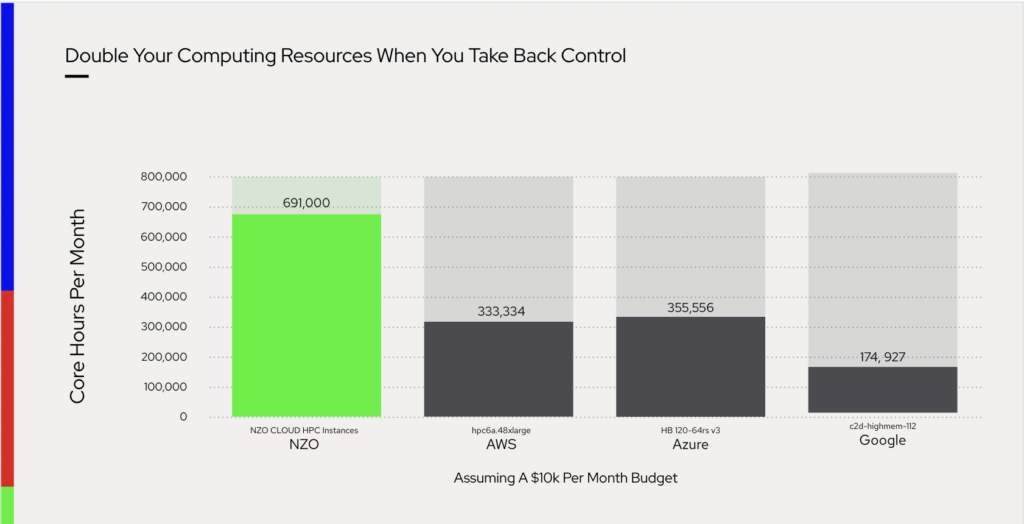
In addition to the cost-related benefits, NZO Cloud also offers customized deployments. Unlike traditional services that require businesses to conform to rigid models, NZO Cloud offers fully customized deployments that are specifically tailored to include only what your business needs, ensuring optimal alignment with your operational requirements. We also provide direct access to onboarding and security engineering teams, ensuring businesses receive the necessary support to maintain a smoothly operating cloud environment.
Understanding Cloud Services Pricing
Cloud pricing complexity is not accidental. Compute, storage, networking, and add-on services are individually metered, creating billing fragmentation. To optimize cost, organizations must understand how each layer contributes to total spend.
How Cloud Server Pricing Works
Compute pricing is typically determined by CPU type, memory allocation, GPU configuration, storage IOPS, and network throughput.
On-Demand vs. Commitment Models
Hyperscale providers rely heavily on consumption-based billing. Small, incremental usage charges accumulate continuously. Reserved instances or savings plans reduce rates but require forecasting commitments that may not align with evolving workloads.
NZO Cloud replaces metered billing with standardized subscription pricing. Customers receive predictable monthly costs and dedicated performance capacity without incremental “tick-tick” charges. This structure eliminates billing volatility while maintaining compute availability.
Premium SKU Inflation
Cloud vendors frequently segment hardware into “premium” instance families. While technically powerful, these configurations often exceed workload requirements. Over-specification inflates spend without delivering proportional performance gains. Purpose-built cloud environments avoid this trap by engineering infrastructure to application specifications rather than marketing tiers.
Cloud Database Pricing and Its Cost Traps
Databases introduce layered costs beyond compute: storage tiers, IOPS scaling, replication, backup retention, and inter-region transfer.
- Oversized Deployments: Preconfigured database templates frequently allocate excess memory or storage. Custom-configured infrastructure avoids paying for unnecessary headroom.
- Hidden Network Dependencies: Load balancers, cross-zone replication, and managed service interconnects introduce additional network charges. Without governance, these defaults quietly increase the total cost of ownership.
- Idle Replicas and Redundant Capacity: Read replicas and standby clusters provide resiliency but often remain underutilized. Governance mechanisms must continuously evaluate utilization-to-cost ratios to prevent dormant spend.
Cloud Storage Enterprise Cost Considerations
Storage costs scale with capacity, access frequency, and transfer patterns.
- Lifecycle Policy Drift: Organizations frequently misalign retention policies with regulatory or operational requirements. Data remains in higher-cost storage tiers longer than necessary.
- Snapshot Sprawl: Automated backups and snapshots accumulate rapidly, especially in development and staging environments. Without cleanup governance, these artifacts multiply storage charges.
- Data Egress Exposure: Transferring data out of hyperscale environments can trigger significant fees. High-performance workloads that move large datasets—common in AI and simulation—are particularly exposed. NZO Cloud includes high-capacity storage within its subscription model, minimizing surprise transfer and licensing charges while simplifying budgeting.
Where Cloud Cost Savings Are Lost
- Idle and Over-Provisioned Resources: Virtualized, shared environments often force customers into predefined instance sizes. Paying for unused CPU cores or GPU capacity creates structural inefficiency. Dedicated infrastructure eliminates virtualization overhead and ensures resources are aligned precisely with workload requirements.
- Forgotten Development Environments: Dev/test clusters frequently remain active beyond project lifecycles. Without centralized governance and fixed cost boundaries, these environments silently generate recurring expenses.
- Over-Retained Storage and Backups: Unmanaged retention policies inflate storage costs. While NZO Cloud simplifies capacity planning with included high-performance storage, traditional vendors monetize incremental growth aggressively.
- Inefficient Purchasing Structures: On-demand pricing exposes organizations to rate volatility. Overcommitting to reserved capacity introduces rigidity. Neither model fully aligns with evolving HPC demand profiles.
Why Visibility Alone Does Not Reduce Cloud Cost
Reporting tools identify anomalies. They do not change the infrastructure. Many organizations invest heavily in analytics platforms that highlight overspend but lack the authority—or architectural flexibility—to re-engineer workloads fundamentally.
Savings often stall because the root cause is structural: shared virtualization layers, rigid instance classes, and vendor lock-in. Migrating within hyperscale ecosystems can be operationally complex, discouraging corrective action.
NZO Cloud changes the execution path. Users gain control over budget, design, performance, and security simultaneously. Dedicated, non-virtualized infrastructure hardware removes resource contention and virtualization overhead entirely. NZO Cloud simplifies security for maximum access control, offering dedicated computing resources and certified application compatibility.
When organizations control architecture—not just dashboards—they convert cost analysis into realized savings.
Where Cloud Cost Savings Are Lost

Even with a budget, cloud spend often drifts upward due to structural waste and limited control. In AI and HPC—where workloads run hot and often nonstop—small inefficiencies compound fast.
Common Sources of Wasted Cloud Spend
- Idle and Over-Provisioned Resources: Standard instance bundles push teams to buy more CPU, memory, or GPU than workloads actually use. Idle VMs, oversized databases, inactive replicas, and underutilized clusters quietly rack up recurring charges. True savings come from aligning resources to workload telemetry—ideally through custom-engineered configurations that eliminate unused overhead.
- Forgotten and Poorly Governed Environments: Dev/test/staging often outlive their purpose. Snapshot sprawl, duplicate backups, and redundant storage tiers then inflate bills over time. Audits help, but automation and clear ownership scale better; subscription models also cap runaway spend.
- Misconfigured and Unoptimized Workloads: Waste also comes from mismatch: high-memory for CPU-bound jobs, premium storage for cold data, replicas without demand, or GPUs that exceed training needs. Monitoring can flag issues, but savings require the ability to redesign the environment—not just observe it.
- Data Transfer and Networking Charges: Inter-region replication, cross-service traffic, and egress fees are frequent “silent” cost drivers for data-heavy workloads. Better placement and routing reduce exposure; pricing models that simplify or eliminate transfer fees prevent surprise charges.
- Inefficient Purchasing and Commitments: On-demand is flexible but volatile; reservations are cheaper but easy to misforecast. For 24/7 HPC, both can lead to overpayment. NZO Cloud’s fixed subscription pricing removes commitment guesswork and billing spikes with predictable, repeatable performance and no surprise charges.
Why Visibility Alone Doesn’t Reduce Cloud Cost
Dashboards can show where money goes, but they don’t change the architecture. Savings only appear when teams can act—yet hyperscale constraints (rigid instance classes, lock-in, and virtualization noise) often block meaningful redesign. Dedicated, non-virtualized PSSC Labs infrastructure removes contention and overhead, while NZO Cloud adds design control, simplified security, and predictable pricing. Sustainable savings come from aligning architecture, pricing, and workload reality—not from better reporting.
Cost Savings With Cloud Computing Start in Engineering
In mature cloud environments, cost is no longer a procurement problem—it is an architectural variable. Organizations that consistently reduce cloud spend by 30–50% do so not through finance-driven mandates, but through engineering-led optimization programs.
In HPC, AI training, simulation, and data-intensive research workloads, infrastructure decisions made during initial design dictate long-term cost structure. Once systems are deployed, the majority of recurring cloud expense becomes embedded in:
- Instance architecture
- Scaling policies
- Storage design
- Network topology
- High-availability assumptions
Cost efficiency, therefore, is engineered—not retroactively negotiated.
Why Engineers Control Cloud Cost
Engineering teams effectively determine the cost ceiling of a cloud environment before the first workload ever runs. Infrastructure design decisions are not neutral—they lock in recurring cost behavior.
Starting at infrastructure build time, the following choices have compounding financial implications:
- Compute architecture selection (general-purpose vs. compute-optimized vs. GPU-accelerated)
- Memory-to-core ratios
- Storage performance tiers (IOPS, throughput classes, caching layers)
- Network throughput and cross-region dependencies
- High-availability configuration defaults (multi-zone, multi-region, failover clustering)
In hyperscale environments, engineers often select from pre-packaged instance families. These bundles simplify provisioning but frequently misalign with workload characteristics. For example:
- A memory-heavy instance may include surplus CPU cores that sit idle.
- A GPU tier may exceed actual model training requirements by 20–40%.
- Premium networking defaults may introduce unnecessary cross-zone traffic costs.
- Multi-region replication may be configured for workloads that do not require sub-second failover.
These mismatches do not appear costly in isolation—but they compound every hour the workload runs, every day of the month.
Engineering-led optimization frameworks emphasize workload profiling before provisioning. CPU utilization curves, memory saturation patterns, IO characteristics, queue depth, and GPU utilization efficiency should inform instance design—not convenience, habit, or worst-case speculation.
Dedicated HPC infrastructure engineered through PSSC Labs removes virtualization constraints and allows component-level specification. Instead of selecting a predefined instance bundle, organizations can align processor architecture, GPU class, memory configuration, and storage throughput directly to application telemetry.
When infrastructure is designed around actual workload behavior rather than vendor-defined templates, utilization improves, performance stabilizes, and structural waste declines. Engineers, not finance teams, determine whether the environment starts efficiently or at a high expense.
Configuration Decisions That Compound Cost
Engineering teams rarely deploy inefficient infrastructure intentionally. Cost escalation typically emerges from default behaviors and risk-avoidance bias:
- Overprovisioning “just in case”
- Leaving test or staging environments active indefinitely
- Retaining snapshots beyond compliance requirements
- Over-architecting high availability beyond SLA necessity
- Enabling autoscaling policies without upper-bound cost guardrails
- Deploying container limits that far exceed runtime utilization
Cloud billing multiplies these incremental decisions continuously. A 15% overprovisioning bias may not appear significant at deployment, but over 12 months of continuous HPC workload operation, it becomes a material budget expansion.
Research in engineering-led cloud optimization consistently highlights three systemic drivers of compounding cost:
- Overprovisioning Bias: Engineers prioritize performance reliability over cost predictability. “Safe” sizing often exceeds actual demand.
- Lack of Real-Time Cost Feedback: Financial impact lags infrastructure decisions. Engineers see CPU spikes instantly—but billing impact weeks later.
- Fragmented Ownership: No single engineering team owns total cloud efficiency. DevOps, data science, platform engineering, and infrastructure teams may each optimize locally while inflating global cost.
Without architectural guardrails, even well-intentioned scaling policies can inflate spend significantly during peak load cycles. Autoscaling without utilization validation can double capacity during transient spikes. Snapshot accumulation can grow storage cost silently.
Subscription-based infrastructure alters this risk profile. NZO Cloud HPC offers predictable, reliable, and repeatable performance with fixed subscription pricing and no surprise charges. For sustained HPC workloads operating continuously, removing variable billing volatility eliminates one of the primary compounding cost drivers—uncontrolled metered expansion.
When price volatility disappears, engineering focus shifts from rate management to architectural efficiency.
Developing Cost-Aware Engineering Habits
Cloud cost optimization must become embedded into engineering culture—not treated as an episodic audit event. The most effective organizations institutionalize cost awareness at the same level as performance monitoring, uptime reliability, and security compliance.
This shift requires moving from “cost review meetings” to cost-aware system design.
Cost as a Design Constraint, Not a Finance Afterthought
Elite engineering teams treat cost as a non-functional requirement alongside performance, availability, and security.
In practice, this means:
- Defining acceptable cost-per-transaction or cost-per-job thresholds before deployment
- Establishing performance-to-cost benchmarks during architecture reviews
- Evaluating infrastructure efficiency at formal design approval gates
- Requiring workload right-sizing validation before production promotion
- Stress-testing configurations for performance-per-dollar, not just throughput
For HPC and AI teams, cost quantification must occur at the workload layer:
- Cost per training run
- Cost per simulation hour
- Cost per dataset processed
- GPU-hour efficiency ratios
- Memory utilization efficiency per core
When cost is quantified at the workload level, optimization becomes measurable—not theoretical. Teams can compare architecture versions and choose configurations that maximize performance per dollar rather than raw compute power.
Users can design custom cloud instances engineered for their needs, ensuring processor architecture, GPU selection, memory footprint, and storage performance align precisely with workload demands. Precision infrastructure design prevents cost inflation caused by generic instance tiers that bundle unused overhead.
Cost becomes a technical variable—not a surprise invoice.
Embedding Cost Signals Into Daily Engineering Workflows
Engineering-led optimization requires immediate feedback loops. Delayed financial reporting weakens behavioral reinforcement and allows inefficiencies to normalize.
High-performing teams implement:
- Cost anomaly alerts embedded in CI/CD pipelines
- Environment tagging discipline tis ied to ownership and lifecycle
- Cost dashboards integrated into engineering stand-ups
- Automated idle resource shutdown policies
- Scheduled rightsizing reviews based on telemetry trends
- Automated policy enforcement for non-production scheduling
The goal is not constant restriction—it is continuous calibration.
Cost telemetry must sit alongside CPU, memory, and throughput metrics. Engineers should see financial impact as clearly as performance degradation. If a scaling event increases the monthly cost by 12%, that signal should appear in the same workflow as utilization graphs.
However, dashboards alone do not solve structural inefficiencies. If infrastructure cannot be resized granularly or redesigned due to virtualization rigidity, insights stall at the reporting layer.
Dedicated, non-virtualized infrastructure simplifies this feedback loop. Performance variability is reduced, utilization metrics are more accurate, and cost-per-core relationships are transparent. Engineers can correlate architectural adjustments directly with performance and cost outcomes.
Reducing Friction Between Insight and Action
One of the most under-discussed barriers to cloud optimization is execution friction. Even when inefficiencies are identified, teams encounter:
- Vendor lock-in constraints
- Rigid instance classes
- Limited granular resizing options
- Cross-team approval bottlenecks
- Dependency chains that complicate reconfiguration
As a result, organizations repeatedly analyze cost reports without implementing structural changes. Optimization becomes theoretical rather than operational.
Engineering-led cost programs emphasize reducing time-to-action:
- Infrastructure-as-code templates that support rapid reconfiguration
- Modular architecture allowing component-level scaling
- Governance policies that empower engineers to adjust without excessive approval overhead
- Defined cost-ownership accountability within engineering teams
NZO Cloud reduces structural friction by combining dedicated infrastructure with design control. Because users control the architecture directly, corrective action does not require navigating hyperscale service abstractions. NZO Cloud simplifies security for maximum access control while providing dedicated computing resources and certified application compatibility.
When infrastructure is purpose-built rather than vendor-packaged, optimization becomes iterative and continuous rather than disruptive and complex.
From Reactive Cost Monitoring to Engineering Governance
Traditional cloud cost management often follows this pattern:
- Finance detects overspend.
- Engineering investigates.
- Minor adjustments are made.
- Costs gradually climb again.
But on the other hand, engineering-led cost governance reverses the sequence:
- Architecture is designed for efficiency.
- Cost telemetry is embedded in workflows.
- Utilization is continuously reviewed.
- Structural pricing stability reduces volatility.
For sustained AI, life sciences, engineering, higher education, and government workloads, cost savings are not achieved by periodic renegotiation of rates. They are achieved through disciplined infrastructure design and predictable pricing models.
Cloud efficiency is not an optimization sprint. It is a continuous engineering practice—one that begins before the first instance is ever deployed.
Practical Strategies for Managing Cloud Cost at Scale

Performance and cost cannot be optimized independently. In HPC environments, performance misalignment is almost always a cost problem in disguise.
1. Configuration-Level Cost Savings
Configuration-level waste is embedded at deployment. If infrastructure is misaligned with workload characteristics, cost inefficiency becomes structural.
Fixing Expensive Defaults
Many cloud environments inherit expensive defaults:
- High-memory instances selected without utilization validation
- Premium storage tiers enabled without IOPS analysis
- Multi-zone redundancy configured beyond SLA necessity
- Network load balancing activated by default
For HPC workloads, instance type selection is the first critical decision. Compute-optimized, memory-optimized, and GPU-accelerated instances behave very differently under load. Selecting the wrong family inflates cost while degrading performance.
Best practice:
- Profile CPU saturation, memory pressure, IO throughput, and network bandwidth before scaling.
- Match instance characteristics directly to workload behavior.
- Avoid overprovisioning “just in case.”
In traditional hyperscale environments, instance families are rigid and virtualized. This bundling often forces trade-offs between performance and cost. Infrastructure engineered at the component level—processor, memory, storage, GPU, and networking—eliminates virtualization overhead and avoids forced overprovisioning. Precision configuration is the foundation of both performance and cost control.
Reducing Over-Retention and Misconfiguration
Configuration drift is one of the most persistent cost multipliers in cloud environments:
- Snapshots retained indefinitely
- Backups exceeding compliance requirements
- Idle read replicas
- Cross-region replication left active after testing
These inefficiencies rarely impact performance, so they escape engineering attention—but they continuously inflate cost.
Monitoring tools should track:
- Storage growth velocity
- Snapshot lifecycle compliance
- Replica utilization ratios
- Network transfer patterns
Eliminating misconfiguration improves cost efficiency without sacrificing performance integrity.
2. Usage-Based Cloud Cost Savings
Even correctly configured environments waste money if usage behavior is unmanaged. Usage-based optimization focuses on dynamic alignment between demand and resource allocation.
Rightsizing Safely
Rightsizing is often discussed but poorly executed. Aggressive downsizing without telemetry validation risks performance degradation.
A safe rightsizing framework includes:
- Reviewing average vs. peak utilization curves
- Validating sustained CPU/memory utilization over 30–60 days
- Testing scaled-down configurations in non-production
- Measuring performance-to-cost ratio improvements
In HPC environments, rightsizing must also evaluate:
- GPU-hour efficiency
- Job queue latency
- Throughput per core
Continuous monitoring is essential. Real-time telemetry allows engineers to detect underutilization early and adjust before waste compounds.
Scheduling Non-Production Environments
Development, staging, and testing clusters are frequently left running outside working hours. Automated scheduling policies can:
- Shut down non-production environments during nights/weekends
- Suspend idle clusters
- Scale down inference environments during low demand
This strategy alone can reduce non-production compute spend by double-digit percentages.
Where workloads are interruptible or non-critical, spot instances may provide additional savings. However, spot capacity must be architected for interruption tolerance. For mission-critical or continuous HPC workloads, volatility may outweigh cost advantages.
Subscription-based models remove the operational complexity of constantly dealing with rate volatility. NZO Cloud HPC offers predictable, reliable, and repeatable performance with fixed subscription pricing and no surprise charges—particularly valuable for 24/7 HPC utilization.
Preventing Idle Resource Accumulation
Idle capacity accumulates silently through:
- Forgotten instances
- Orphaned storage volumes
- Detached load balancers
- Underutilized autoscaling groups
Automation should enforce:
- Idle instance detection
- Auto-termination policies
- Environment tagging tied to ownership
- Expiration dates for temporary resources
Cost telemetry should be embedded into engineering dashboards—not isolated within finance reports. Engineers should see cost impact alongside CPU, memory, and throughput metrics.
3. Rate-Based Cost Savings
Even with optimized configuration and usage discipline, your pricing strategy determines long-term cost efficiency.
Commitment Planning Aligned to Real Usage
Traditional hyperscale pricing presents two primary models:
- On-demand (flexible but volatile)
- Reserved commitments (discounted but rigid)
Engineering teams often struggle to align commitment purchases with real workload behavior. Overcommitting leads to stranded spend. Undercommitting results in paying premium on-demand rates.
Commitment planning must be based on:
- Baseline steady-state utilization
- Seasonal demand cycles
- GPU utilization stability
- Storage growth projections
For sustained HPC workloads running continuously, fixed subscription pricing eliminates commitment arbitrage risk entirely. Instead of forecasting multi-year consumption curves, organizations secure predictable monthly capacity.
Avoiding Over-Commitment Risk
Reserved instance strategies assume accurate forecasting. In dynamic research, AI experimentation, or evolving engineering programs, forecasting precision is difficult.
Over-commitment risk manifests as:
- Paying for unused reserved capacity
- Being locked into obsolete instance families
- Inflexibility during architecture evolution
Dedicated infrastructure eliminates this tension. Infrastructure engineered specifically for workload requirements reduces reliance on financial instruments to achieve cost control.
NZO Cloud simplifies security for maximum access control while delivering dedicated computing resources and certified application compatibility. When performance is consistent and pricing is stable, organizations focus on throughput and research output—not rate arbitrage.
Measuring and Sustaining Cloud Computing Cost Savings

A lower bill is not proof of maturity. Sustainable cloud cost optimization means savings are measurable, repeatable, and resistant to regression. In HPC and AI environments—where workloads scale quickly—cost governance must function as an ongoing performance discipline, not a one-time cleanup.
Metrics That Matter
Tracking total spend is insufficient. Focus on metrics that reveal structural efficiency:
1. Savings Realized vs. Savings Identified
Finding waste is not the same as eliminating it.
- Identified: Potential savings flagged by analytics.
- Realized: Actual recurring spend reduced.
The gap exposes execution friction. Dedicated, component-engineered environments reduce that gap by enabling faster corrective action.
2. Time-to-Remediation
Measures how quickly inefficiencies are corrected.
Shorter cycles indicate strong engineering ownership and governance maturity.
3. Waste Prevention Rate
Quantifies how much waste is avoided through automation and guardrails (e.g., auto-scheduling, snapshot expiration, rightsizing validation).
Prevention is structurally stronger than cleanup—especially in fixed subscription models like NZO Cloud HPC, where volatility and surprise charges are eliminated.
4. Performance-to-Cost Ratio
Cost must be measured against output:
- Cost per simulation hour
- Cost per training run
- GPU-hour efficiency
- Throughput per core
True optimization improves performance per dollar—not just reduces spend.
Core Sustainability Metrics
| Metric | Purpose | Target |
| Savings Realized vs. Identified | Measures execution gap | Minimize gap |
| Time-to-Remediation | Speed of correction | Reduce cycle time |
| Waste Prevention Rate | Automation effectiveness | Increase |
| Performance-to-Cost Ratio | Output per dollar | Improve |
| Idle Resource Ratio | Overprovisioning signal | Near zero |
| Commitment Utilization Rate | Avoid stranded spend | High alignment |
Preventing Cloud Cost Regression
Savings erode through configuration drift, unmanaged scaling, staff turnover, or architecture changes. Prevention requires embedding cost governance directly into engineering workflows.
Continuous Validation
Optimization must run continuously—not quarterly.
Best practices include:
- Automated idle detection
- Regular rightsizing reviews
- Real-time cost anomaly alerts
- Commitment utilization monitoring
Cost telemetry should appear alongside performance metrics. Dedicated, non-virtualized infrastructure improves accuracy by eliminating shared-resource distortion.
Guardrails Instead of Cleanup
One-time cost reductions rarely last. Durable savings require:
- Infrastructure-as-code standards
- Automated snapshot and lifecycle policies
- Deployment validation rules
- Non-production auto-scheduling
- Autoscaling limits with cost boundaries
Guardrails shift cost control from reactive correction to proactive design. Fixed subscription environments like NZO Cloud HPC further reduce regression risk by removing billing volatility.
Making Savings Repeatable
Sustainable optimization follows a disciplined loop:
- Design precisely for workload needs
- Monitor utilization continuously
- Automate correction
- Validate performance-to-cost alignment
- Adjust before inefficiency compounds
For AI, research, and HPC workloads, cost savings must be engineered—not reviewed. When governance, automation, architecture, and pricing align, optimization becomes continuous—and savings endure.
Conclusion: Turning Cloud Cost Savings Into a Continuous Advantage
Cloud computing cost savings are not limited by a lack of data. Most organizations already have dashboards, billing exports, and analytics platforms that can identify inefficiencies. The real constraint is execution. Cloud cost control is a delivery problem—not a reporting problem.
Savings stall when insights cannot be translated into architectural change. Rigid instance families, commitment lock-in, virtualization overhead, and fragmented ownership often prevent organizations from acting on the inefficiencies they detect. Reviewing reports does not lower cost. Rebuilding infrastructure design does.
Organizations that move from analysis to execution follow a different pattern:
- They treat cost as an engineering variable, not a finance afterthought.
- They align hardware architecture and cloud software pricing deliberately.
- They embed cost telemetry into engineering workflows.
- They implement guardrails that prevent regression rather than relying on periodic cleanups.
- They choose pricing structures that eliminate volatility before it compounds.
When dedicated, purpose-built infrastructure from PSSC Labs is combined with NZO Cloud’s predictable subscription model, cost control becomes structural rather than reactive. Performance integrity and financial stability reinforce each other instead of competing.
The final takeaway is straightforward: sustainable cloud cost savings are determined by how teams build systems—not how often they review invoices.
When infrastructure is engineered precisely, and pricing is designed for predictability, cost efficiency stops being a quarterly initiative and becomes a continuous operational advantage.
Gain peace of mind with your cloud budget and boost performance with NZO Cloud. Start a Free Trial today.